
Humans are uniquely unique. It’s true that Star-nose moles have unique electro-sensory abilities; elephants can pick stuff up with their trunks and there are countless examples of living creatures that are unique and fascinating in their own right. But where humans are uniquely unique is our ability to do or recreate the ability to achieve all these things, and more. We can make a machine to pick something up, we have invented electro detection and sonar and we have entered into space.
We have been able to do this through technology created by culture and community: working together.
Through human sociality we have learnt to amass information, ratchet it up by standing on the shoulders of our predecessors to build new things, invent new ways and organise into successful progressive society. From an arrow head made from flint to a Smartphone, agriculture to biochemistry, and the Renaissance’s blast furnace to CERN’s Large Hadron Collider.
Humans are not necessary unique in their altruistic tendencies. In fact all animals are altruistic; we’re not unique in that sense. It’s true that the more you are related to someone the more likely you are to help them. The Price/Hamilton equation shows to what extent an animal will help the fitness of the group at the detriment to its own. This is a genetic trait that informs an organism to assist other organisms that share their genes. It’s a selfish trait to ensure the genetic code is passed on.
But for the very same reasons we might help our neighbour, we may also therefore not be so kind, if they were causing a detrimental effect to the group. It could be argued that both sides of this “selfish” gene explains the majority of human behaviour on the planet. How humans can be extremely kind, compassionate and caring but also being cruel, cunning and careless.
Alliteration aside, what about the big question: why are there arguments with on Christmas day with your family over Monopoly? Those family members are a close relation and according to the Price/Hamilton equation should be extremely altruistic. Perhaps there’s more to it, perhaps capitalism, in the form of Waddington’s classic, isn’t good for society after all? But that’s another argument for another day. Or is it?
Fulfilling your hierarchy of needs?
So we are both good and evil at heart? Perhaps, but I do think there is something to be said for the effect the environment has on human behaviour. The circumstances in which we find ourselves directly affect our relationships. The more our needs, as proposed in Maslow hierachy, are fulfilled the more energy and thought we can put towards higher things: our culture, creating things and being part of a community.
Maslow’s Hierarchy of needs
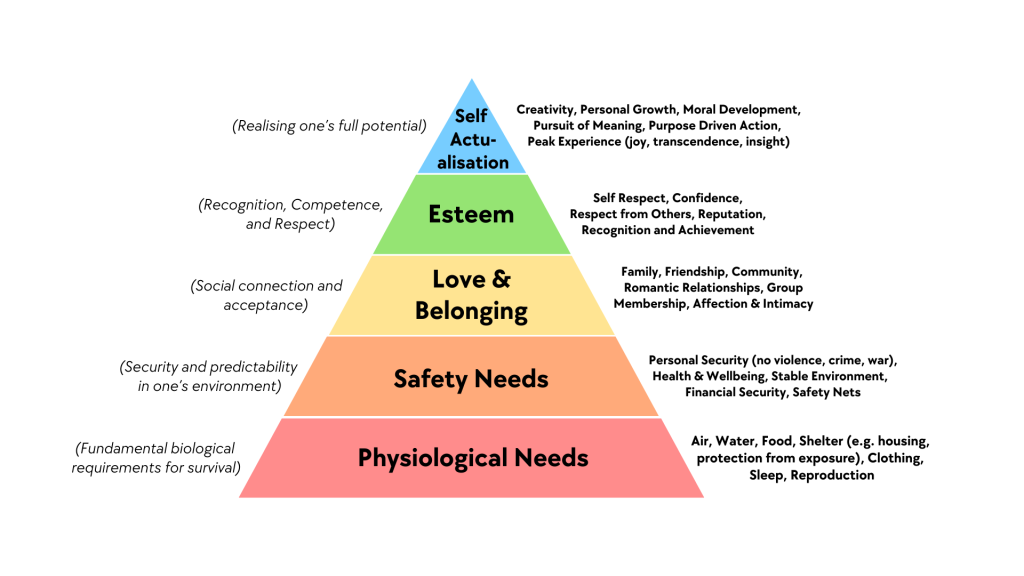
As proposed in “A Theory of Human Motivation” in Psychological Review, 1943.
If humans are struggling to survive then you would assume we will try and eat, take shelter, defend ourselves and resort to our primal instincts before helping others. Whereas if we are physically safe, socially satisfied and spiritually enlightened then we are far more likely to extend compassion and perform charitable actions.
Half full, half empty?
The harmonious utopian future, that we are all secretly striving to reach but are all equally pessimistic about the materialisation of, can be achieved (Park Life). How? By collectively satisfying Maslov’s hierarchy of needs. By doing what humans do best: inventing news ways to do things, collecting locally and organising society, helping one another to not only survive but to thrive.
There’s no doubt that the economic growth seen in the last century has improved the lives of the 7bn+ inhabitants.
Most countries have progressed along Rostow’s Stages of Growth model from Traditional Societies, Preconditions for take-off, Take Off, Drive to Maturity and the end game: Age of High Mass Consumption. Lead by the Western Europeans and Japanese, dominated by the USA and now owned by China. Many have benefitted greatly, some have stagnated difficultly, and others have suffered inexcusably and had slow painful progressions to economic success.
It’s true that the wealth generated by economic activities has fed, clothed, and sheltered billions, but not all. It has also helped some people socialise, play sport, and reduce
manual labour. It has, quite literally, fuelled the jet, atomic, space, and information ages and allowed for the digital revolution. The United Nations’ (UN) Millennium Development Goals have shown there has been great progress across the world in saving and improving the lives of the world’s inhabitants.
So, like Bill Hicks said: “Everything is O.K., go back to bed America”
Everything is not okay. There is disparity between people. There’s a gulf between rich and poor, healthy and sick, blessed and banished. There’s an unequal concentration of power and wealth and, of course, there’s also a long running ecological imbalance that threatens all of the semantics above. There are barriers. And there is fear. And there are people fanning the flames of these fears. I’m looking at you Nigel and Mr O’Reilly. But there’s no need to give them any more airtime.
The glass is half empty but filling up.
For all the struggles, disasters, atrocities there is triumph, success and happiness. The advancement in technology, the digital world and the dissemination of information has led us to a significant point in time. Now!
And there’s hope. But not like Obama’s once promised but now faded hope: a demonstration of how the state cannot provide all the answers. Nor can the markets. Therefore the forth sector exist to fill the huge gaps.
Approximately 2.3 billion people worldwide having helped a stranger in the last month. And this type of charity is increasing. It is true that there are two slight hiccups that need addressing:
Aid money hit a record high $134.8 billion in 2013, but shifted away from the poorest countries and the amount of money donated has fallen marginally between 2013 and 2014.
But, there really is hope.
There is a global force for good beginning to emerge.
There is an understanding and awareness that people are compassionate. There are people that are reinforcing the motion that short term gains, political cycles and profit for profits sake is not advantageous to the future of the human race. There’s a locally focussed but globally aware revolution. A generation of people that care and want to be creative and live in a community based around compassion. There are the “connecting people”.
These people span ages, and have differing backgrounds and even interests but they share understandings and the mindfulness to help others.
They are the people to help “reach more people, inspire more giving and raise more money.”
They are the charities, the fundraisers and the givers and they need technology innovation like never before.
If humans do have the ability to be caring or cruel then what are the conditions for breeding compassion? Lets understand them, nourish them and unleash them.
It’s Generation C.
Leave a Reply